Friday, April 25, 2014

A Manifesto on Domestic Woods

Quartersawn white oak back and sides which came from a local farm.


When I started building guitars I was very enthusiastic about using domestic woods.  The first guitar that I made had white oak back and sides, wood that came from a farm not far from my house, a maple neck and fingerboard, and a red spruce top. I had salvaged the maple from an old beam in a barn that I had worked on.  I used white oak for the first half dozen guitars that I made.  It's fantastic wood.  It works nicely, bends like a dream (they use it for barrels and boats), has a great tone, it was used on many guitars from the early 20th century, and when it is quartersawn, it's beautiful. 
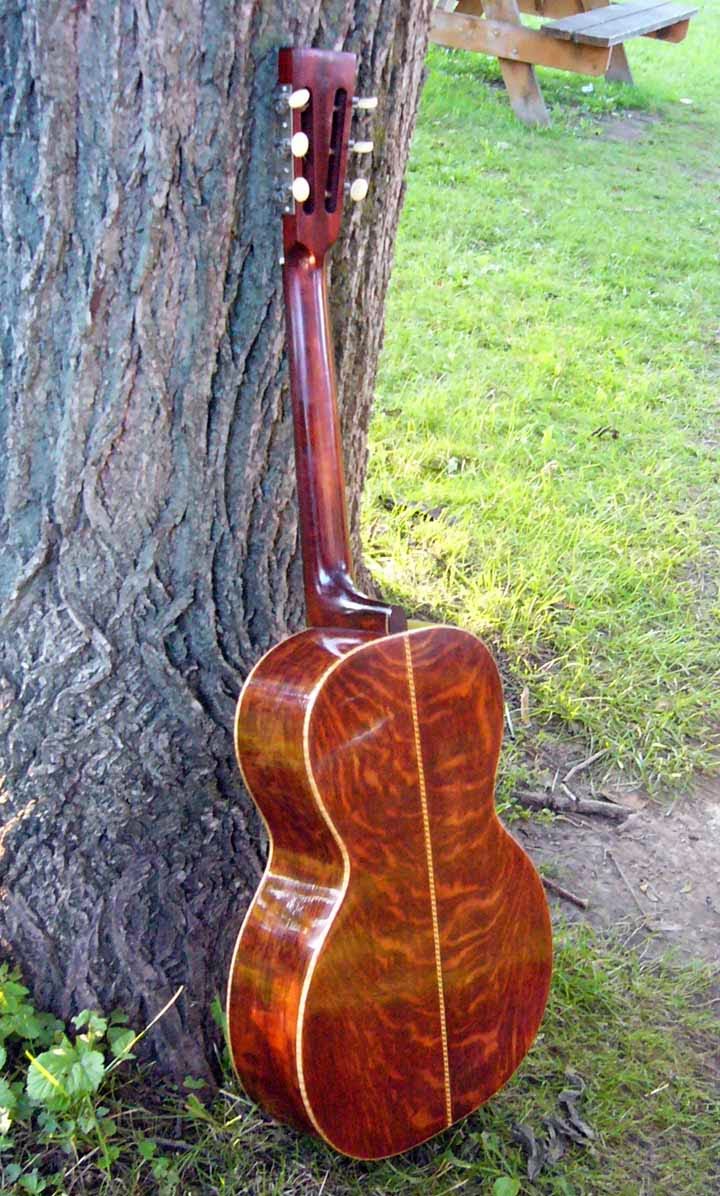


White oak parlor

As the great luthier Al Carruth told me, "White oak is one of my favorite tonewoods.  The only problem is selling it!"   I was once at a guitar show with a white oak guitar.  There was a fellow who saw the guitar from across the room.  He came over to my booth and was captivated by it.  He
asked if he could play it and he strummed a few chords and said, "That sounds great!  What kind of wood is this?"  When I told him it was white oak, he promptly put the guitar back on the stand and without a word turned and walked away.  Al Carruth was right.


As time went by and I started building guitars full time, I found myself using domestic woods less.  I began using mahogany more, occasionally koa or rosewood, because that's what my customers wanted.  Once in a while someone would request a guitar with white oak, birch, maple or walnut for the back and sides, but for the most part people were skeptical.  I've used red spruce, which comes from the northeastern U.S. on the majority of my instruments.  Red spruce is highly regarded and prized in the guitar world, though it wasn't always that way.  I've also used poplar for necks, something which was done quite a bit in the old days, but which has fallen out of fashion and is no longer a consideration for most builders.  The old Galiano that I play has a poplar neck which has remained straight with no reinforcement for the 90 plus years it's been alive.

It has surprised me that in a supposed age of environmental awareness, the use of domestic woods has not caught on.  There are a few independent builders who use them on occasion, but the big companies seem to stay away.  Martin made some white oak guitars a few years back, but the wood they used came from England.  They are currently making some guitars using cherry, which the deserve credit for.


Sunburst on birch back

 I see the use of domestic woods in guitar making as a cycle that is in need of a paradigm shift.  There is little demand for instruments made of domestic wood because there are few instruments being made of it and people haven't had the chance to play and hear instruments made with the stuff.  Guitar makers and companies make a good margin off of marking up the prices of wood, and people seem to want exotic wood, as they equate exotic wood with good tone and that is what they are familiar with.  So the incentive for the maker is to use exotic woods, the more rare the better. 


Sunburst on maple
Another factor is that sets of domestic tonewoods are hard to come by.  Because there is little demand from customers or builders, many of the larger suppliers of tonewood don't bother carrying them in their inventory.  I was once asked by a large wood supplier if I had any suggestions for their company.  I suggested that they carry sets of white oak and birch and market it as environmentally responsible, locally sourced wood that was easy to work with and good for people who were building their first guitar.  They looked at me like I was a lunatic and never followed through.  I did appreciate that they asked for my feedback.  Suppliers would rather source wood from Africa, Asia, India and South America and in some cases certify it as "Sustainably Harvested" (never mind the fact that it has traveled halfway across the world to get to the supplier), than contact local mills for a source of domestics.  Looking at the sites of two of the biggest tonewood suppliers, the only domestic options for back and side wood are cherry and maple.


So if a builder wants to use domestic wood they have to find the wood and  resaw it themselves.  This is what I've always done in the past but it makes the whole process of building a guitar that much more complicated.  Resawing is not an easy task, it requires the right equipment and there is quite a bit of time involved.  It's much more convenient (and cheaper if you take the time to resaw into consideration) to order a set of wood from a supplier which is already milled to the proper dimensions. There are some smaller suppliers who carry domestic sets, but they are often difficult to find.

Talk is cheap though.  The proof is in the pudding.  I've included some photos of some of the guitars I've made with some highly figured domestic woods for the back and sides.  They certainly look nice, you'll have to take my word for it that they sound good too.  In most of these cases I've only used domestics for the back, sides and top.  For the necks I've used mahogany (the white oak parlor has a poplar neck), and for the fingerboards and bridges either ebony or rosewood.  Here are a few examples of instruments I've made using domestic woods for the entire instrument:


1. Bajo Sexto: A few years back I made a copy of a bajo sexto  made in the 1950's by Martin Macias.  Like many of the one man shops of his day, Martin Macias used the wood that was locally available to him.  For the guitar which I copied he used walnut for the back and sides, fingerboard and bridge, poplar (which he called "magnolia") for the neck, and pine for the top.  I used all the same woods, but opted for red spruce for the top.  I especially liked using the walnut for the fingerboard and bridge as it's difficult to find a good domestic hardwood for this application.  The walnut worked wonderfully and was comparable to many rosewoods which are often used for these parts.


Francesca with poplar b&s


Stella 12 with poplar back
2. Francesca 12 string: Last year I restored two Stella 12 strings from the 1920's.  I have worked on a lot of Stellas over the years, but on the first one of these, I realized that the wood used for the back and sides, which I had always assumed was birch because everyone referred to it as birch, was actually poplar.  I had long known that Oscar Schmidt used poplar rather extensively for necks and occasionally fingerboards, but I hadn't considered that they would have used it for back and sides.  The guitars are very often dirty inside and it can be difficult to identify the wood, but on one of the old 12 strings I had to take the back off and upon cleaning the wood I realized that it was poplar.  It totally made sense and went along with everything I have always thought about Oscar Schmidt's production ethic, poplar was inexpensive, it takes stain wonderfully and it doesn't have pores, which means that you can skip the step of pore filling which is one of the most time consuming steps in finishing, and time is money.  I immediately wanted to try building a poplar 12 string but I had to wait until I could find a customer who was interested. 


Not to long after I was contacted by a Blind Willie McTell acolyte who requested a guitar like one of Willie's old Stella 12s.  I talked to him about the poplar and he was game.  I used red spruce for the top, poplar for the neck back and sides and maple for the fingerboard and bridge.  I stained the maple black so that it would look "ebonized", like the fingerboards on the old Stellas.  The guitar turned out great.  It was very light in weight, sounded great and looked like it rolled out of the 1920's.

maple board & bridge
poplar back


Anunziata with Hemlock top.


Hemlock top.
3. Hemlock and White Oak Anunziata - My friend Clancy is a timber framer who has a sawmill.  He and I are always talking about wood.  Recently Clancy came across some hemlock which had been salvaged from some massive beams in an old warehouse built in the early 1900's. It had probably grown in Wisconsin before the North woods were clear cut.  Clancy had resawn the beams to use in a project and he had some nice quartersawn cutoffs which he gave to me. The more I looked at the hemlock the more it reminded me of some of the wood used on tops of guitars built in the early 20th Century, especially some of the early Chicago made guitars.  I used the wood on a couple of projects and I was more than satisfied with the results.  It sounded great and with a coat of varnish it immediately look old and warm.

I built a guitar for Clancy and his wife Sara and wanted to use wood which he had given me over the years.  I used the hemlock for the top and some white oak for the back and sides.  For the neck I used poplar and for the fingerboard and bridge I used some walnut from a tree that I cut down back in my carpenter days.  The guitar has a very plain and simple but elegant look to it.  It sounds fantastic.


White Oak Back


In conclusion, I think it's up to all of us.  As builders we need to try to use more domestic woods, even if it's only for one or two guitars a year.  Experiment with different woods and get educated about them.  If builders start using more domestic woods, they will see that it is great stuff and compares very favorably with the exotics, and sometimes exceeds them.  As customers, we need to ask builders about domestic woods and consider them as an option.  They can be beautiful, sound great and there is a historic precedent for them.  Eventually the idea will catch on an some of the big guys will start carrying sets and the bigger makers will use more of them.  It's much like organic food, years ago it was only hippies and back to the landers who would grow and eat organics. It took many years but it eventually caught on and now you can buy organic food at Wal Mart, which is not a bad thing.

Saturday, February 8, 2014

A Whole Bunch of Guitars

 I have been a bit negligent of the blog, but nevertheless busy in the shop.  I figured rather than write a post with a specific subject, the best way to catch up would be to post photos of some of the work I've done since the last post.  So here goes:

Numero Uno:  Here's a nice little 14 Fret Anunziata that I made for my friend Jack Klatt.  Jack is a great guitar player and singer/songwriter from Minneapolis, Minnesota.  He's an excellent fingerpicker and fabulous writer of ballads.  Check him out at his website http://www.jackklatt.com/.  Jack told me he wanted a 14 fret, smaller bodied guitar.  As I was in an X bracing frame of mind and as I thought something along the lines of an old Gibson would be suitable, I decided to make him a very lightweight, X braced, 0 sized, plain Jane Anunziata.  It's a great sounding little guitar.  I think it was in the 3lb range.  He's been traveling the country with it and sounding fantastic.


Next up;  Ernie Hawkins contacted me and asked me to make him a rosewood guitar.  He had played the 14 fret Angelina that I made for Mary Flower and said that it was the first rosewood guitar that he ever liked.  He said he wanted something like Mary's but with more of a plain look.  I made him a 14 fret X braced Angelina, 00 sized, red spruce top, Madagascar rosewood back and sides.  A powerful sounding box.  I look forward to hearing him work his magic on it someday.


Round Three:  I had the opportunity to build another Leadbelly 12 string, bound for Austin Texas.  I always enjoy building Leadbelly guitars.  The challenge on this one was the pickguard.  I haven't put one on one of my copies and it was such a prominent aesthetic element of Leadbelly's guitar.  It was fun tracking down photos of him with the guitar and scaling out the pickguard and making a pattern.  Rather than screwing it directly into the top, as it was on the original, I opted to put in two false screws and adhere it to the guitar with padded double sided tape.  This way it has the look of the old one but the screws invite cracks.  With the tape, the guard can be removed with no damage to the guitar.


Numero Quattro, the Wild Child, ladder braced Angelina:  David Bragger is a great player of blues and old time music in Los Angeles.  David wanted something unique and suggested the idea of a blue guitar.  The challenge was to make it look classy, less like a cheap Chinese made blue instrument, more like a 1930's hallucination.  Classy may not be the right word, but it is definitely unique and makes a statement.

In addition to the blue, I upped the ante by adding a layer of glitter.  I varnished over the blue and the glitter.  The back and the sides were nice flamed birch, maple neck, ebony fingerboard and bridge. The glitter was a bit of a challenge.  It plagued all of my French polishing pads which I had to throw out at when the guitar was finished and start fresh.  Nevertheless I'm glad I did it as it really added to the overall look.  I had some old stock pearloid from the Harmony factory which I used for the peghead veneer and pickguard. 


Numero Cinque:  My friend Alvin Youngblood Hart was in town last Spring.  Alvin was very instrumental in me becoming a guitar maker.  I made him a 12 string about 12 years ago and he's been traveling the world with it ever since, and I'm honored that he's done so.  I've offered to make him a newer 12 a few times as I've learned a few things in those years, but he's always declined as the guitar suits him fine.  When he was here though he did say that he may be interested in a six.  The only guidance I was given was that it needed to have a solid peghead, and that he liked the old Regal Coke bottle headstocks.

Alvin's a ladder braced dude.  He hipped me to that style and I was going to stay true to it.  I wanted to make him something that looked like it was from the mid to late 30's, bigger box than his old Stella but with the same scale.  I made him a 12 fret Angelina with a 24.9" scale, birch back and sides, hand rubbed sunburst varnish finish.  I really dig this guitar and hope to hear him playing it soon.


Numero Sei:  My friend Eden Brower of the East River String Band wanted a small guitar as she is a rather diminutive young woman and has had trouble finding a guitar that fit her.  I have a couple cheap kids guitar that kick around our house that my boys play on and I find myself gravitating toward from time to time.  I also have a small guitar that Antonio Cerrito built in the 1910s or 20's.  I decided to make a new model based on a combination of these two.  Some folks call a guitar like this a terz, I'll opt for a small guitar.

Eden gave me the direction, "I like black and pink".  The spruce top has an ebonized finish, the paduk back and sides have a pink varnish.  There are skull, heart, liquor bottle and "Slum Goddess" inlays, and an inlaid pink leopard skin pickguard.  The rosette is reminiscent of the grooves of a record, as records play a prominent role in her life. The scale is 22".  With the short scale it can be tuned up to G, but she tunes it to standard pitch.

While I was laying out the top for the guitar, I realized that I could get another top out of the scrap of spruce which was left over.  I joined that scrap spruce and pulled out some wood from my scrap box which is full of cutoffs and mistakes and made a guitar for my boys.  Really it was a guitar for myself to play around the house, but the kids were a good excuse.  That is the blonde one.


Numero Sete:  Rami Gabriel, a great jazz guitar player from Chicago asked me to build him a 14 fret Felix like the one I made for Craig Ventresco.  Rami was digging the sunbursts I've been doing lately and I was happy to do another.  He was looking for something loud and punchy so I decided to ladder brace it, and use maple for the back and sides.  It's a honking good box.


Numero Otto:  A friend in North Carolina asked me to build a Loretta like the black one I built earlier in the year.  It was a great pleasure to do another one of these.  A ladder braced parlor with an ebonized top and inlaid pickguard.  This guitar was very light in weight, I think it was 2 lbs. 10 oz.  24 1/4" scale.  Despite it's small size, this guitar can really bark.


Finally, A nice little Erma which was Chicago bound.  Adirondack top, mahogany back and sides, mosaic purfling that I made, engraved fret markers, varnish finish.  This is my take on the Stella concert guitar, true to the old form but a little more refined. It is a lovely sounding box and I'd love to have one like this around the house.


There they are, the guitars that closed out 2013.  There are some new ones on the bench and I'll try to be better about posting them as they are completed.

Tuesday, April 30, 2013

The Many Faces of Loretta


 Fraulini was my grandmother Angelina's maiden name.  There were seven sisters in the family and I have named a model after each one of them.  My great Aunt Loretta was the baby of the family and is the last surviving sister.  She is in her 90's and doing well.  She always gives me a hard time that the model that bears her name is the "cheapest", but I like to remind her that it is also the most petite and sweetest, which usually gets her to ease up on me a bit.  This year I have found myself making a surprising number of Loretta's, each very unique in their own respect.  It started me to thinking that there is quite a bit of variation that can be done with a basic shape.  I thought it would be interesting to put up pictures of the three to compare and contrast.


The Loretta is a parlor guitar, modeled after some of the great guitars made in Chicago in the early 1900s.  It's short 24" scale makes it very nice to play as the strings are slack which gives it a very comfortable feel.  The first of this batch is one I've written about before, a fairly plain guitar, with a black spruce top, mahogany back and sides.  It's only noticeable trait is the leopard skin pickguard.  The plain look really makes the pickguard pop.  I've been calling this one The Black Widow.


The second of the batch is on the fancier side.  The same pickguard shape, with an inlaid mother of pearl flower.  The spruce top has a nice multi layered mosaic purfling which I made a while back to match some old Larson brothers purfling, ebony whale tail bridge and fingerboard, diamond fingerboard inlays and rosewood back and sides.  I really like the look and sound of this guitar.  I've been playing it in open G for the past month or so and it's been fun to listen to it open up.


The final guitar of this batch is a 12 string.  This guitar is loaded with inlay, fancy purfling, beautiful tuners and some fine ribbon mahogany.  The customer wanted to be able to tune the guitar up to E, with the 24" scale this works beautifully with a light 12 string set.  The guitar sounds great and is a real joy to play.  Quite fetching to boot!

So there they are, three of the same, very different guitars built within a few months of each other and each headed off to different points on the globe.  Each one is very much one of a kind.  All a joy to build.